  |



 




YOUR DONATIONS ARE NEEDED TO HELP AS MANY HOMELESS BORDER COLLIES AS POSSIBLE
|
|
|

What does a Border Collie look like? "Diversity"
is the Key Word
Because Border Collies are bred for intelligence
and working ability and not for looks, there is a
great deal of diversity in appearance.
|
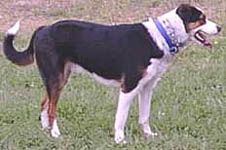 COAT:
Border Collies can have smooth (short)
coats, like Teddy, right, or rough (long) coats
like the three dogs below, or anything in between.
A very long, very heavy coat could be a hazard
to a working dog, so that type of coat may be
more unusual. However, with the advent of show
Border Collies, coats in dogs bred from show
stock are becoming heavier. Coats may be straight
to curly - this is not a standard, but a fact.
The coat is double with a longer, coarser outer
coat, and a shorter softer undercoat which sheds
out completely in summer. A dog under stress
or a female that has recently whelped a litter
of pups may have "blown" their coat so that
it does not appear to be double. COAT:
Border Collies can have smooth (short)
coats, like Teddy, right, or rough (long) coats
like the three dogs below, or anything in between.
A very long, very heavy coat could be a hazard
to a working dog, so that type of coat may be
more unusual. However, with the advent of show
Border Collies, coats in dogs bred from show
stock are becoming heavier. Coats may be straight
to curly - this is not a standard, but a fact.
The coat is double with a longer, coarser outer
coat, and a shorter softer undercoat which sheds
out completely in summer. A dog under stress
or a female that has recently whelped a litter
of pups may have "blown" their coat so that
it does not appear to be double.
EARS: Border Collies
also have two types of ears, erect, like the
two dogs immediately below, and semi-erect (which
actually covers a whole spectrum of ear carriage;
more on ears, below).
BODY TYPE: Please
note that a Border Collie's body shape is very
important in identifying the breed. The Border
Collie has a long body, with the back slightly
sloped toward the shoulders, with legs proportional
in length to the body so as to allow a great
deal of speed and agility.
TAIL: The Border
Collie has a long tail, coming at least to the
hock, and it is held down, often in a "J" formation
or sometimes held tucked under the belly. Some
young Border Collies will hold their tails up
or even curled when in a "play" mode. Even in
the smooth coated dogs, the tail is somewhat
bushy rather than feathered like a setter's,
or smooth like a greyhound's.
HEAD: The Border
Collie's head is wide, but not coarse, and the
muzzle is slightly long in proportion, and pointy
but not sharp. In other words, a wide or blunt
muzzle is not indicative of the breed.
|
|
|
|
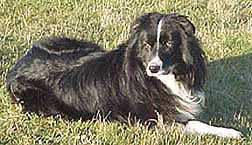
COLOR: The
Border Collie comes in a remarkable variety
of colors.
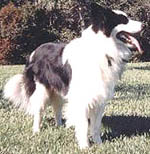 Black
(black-and-white) is the most common
color and often preferred by shepherds.
But even black-and-white dogs come in
a variety of patterns, with varying amounts
of white, usually in the traditional "collie
markings" of a white blaze on the face,
a white collar, feet, chest and tail tip.
Even mostly black dogs will have some
white, usually on the tip of the tail,
the chest and belly, and a little on the
face, if nowhere else. Completely black
dogs are not at all usual in this breed,
and should be considered as something
other than a Border Collie. Black
(black-and-white) is the most common
color and often preferred by shepherds.
But even black-and-white dogs come in
a variety of patterns, with varying amounts
of white, usually in the traditional "collie
markings" of a white blaze on the face,
a white collar, feet, chest and tail tip.
Even mostly black dogs will have some
white, usually on the tip of the tail,
the chest and belly, and a little on the
face, if nowhere else. Completely black
dogs are not at all usual in this breed,
and should be considered as something
other than a Border Collie.
|
|
|
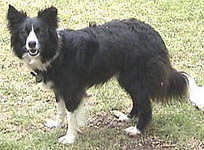
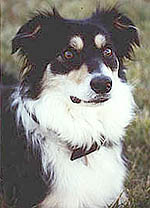 Tri-colored
(black, white and tan), like Tess,
right, is the next most popular color
in the Border Collie. Usually the tan
appears in spots on the face over the
eyes and on the cheeks, sometimes on the
legs, and often among the hair under the
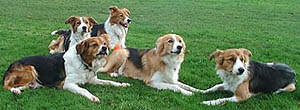
tail or behind the back legs. However,
tan can appear in varying amounts, as
indicated by the group of dogs below who
are technically tri-colored but have large
amounts of tan on their bodies and a black
saddle of varying widths. These dogs are
often termed "saddle-patterned tris".
The tan color may be any shade from very
light "beige" to a deep, dark, reddish-tan. Tri-colored
(black, white and tan), like Tess,
right, is the next most popular color
in the Border Collie. Usually the tan
appears in spots on the face over the
eyes and on the cheeks, sometimes on the
legs, and often among the hair under the
tail or behind the back legs. However,
tan can appear in varying amounts, as
indicated by the group of dogs below who
are technically tri-colored but have large
amounts of tan on their bodies and a black
saddle of varying widths. These dogs are
often termed "saddle-patterned tris".
The tan color may be any shade from very
light "beige" to a deep, dark, reddish-tan.
|
|
|
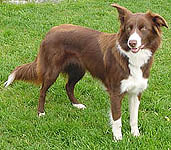
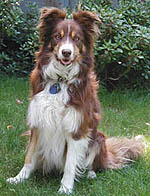 Red
(red-and-white, like Komet, below,
and red-tri
- red, white and tan - like Flash, right)
is not uncommon. Red in a Border Collie
(which is called chocolate in Australia),
is genetically liver or brown (as in the
Springer Spaniel), but the shade varies.
It also comes with the white collie markings.
Sometimes Border Collies will have one
erect ear and one semi-erect, like Komet
does. Flash has "perfect" semi-erect ears,
with just the tips forward. However, please
note that, unlike a "Lassie" collie's
ears, Border Collies' ears are placed
wider apart, and the tips turn slightly
outward. Often Border Collies have ears
that are held all the way down, or with
most of the ear tipped forward - these
latter are sometimes called "tag ears"
(see the pup at the bottom with the one
blue eye). Red
(red-and-white, like Komet, below,
and red-tri
- red, white and tan - like Flash, right)
is not uncommon. Red in a Border Collie
(which is called chocolate in Australia),
is genetically liver or brown (as in the
Springer Spaniel), but the shade varies.
It also comes with the white collie markings.
Sometimes Border Collies will have one
erect ear and one semi-erect, like Komet
does. Flash has "perfect" semi-erect ears,
with just the tips forward. However, please
note that, unlike a "Lassie" collie's
ears, Border Collies' ears are placed
wider apart, and the tips turn slightly
outward. Often Border Collies have ears
that are held all the way down, or with
most of the ear tipped forward - these
latter are sometimes called "tag ears"
(see the pup at the bottom with the one
blue eye).
|
|
|
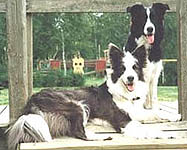 Blue
(or grey), like Hazy, right at
front, is less common a color. Here, Hazy
is shown with Whisper, a black-and-white
dog, so the contrast is evident. Blue
(or grey), like Hazy, right at
front, is less common a color. Here, Hazy
is shown with Whisper, a black-and-white
dog, so the contrast is evident.
|
|
|
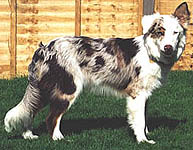
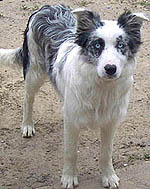 Often
when a blue merle
(like Bill, right) or red
merle (like Matisse, below) dog
comes into a shelter, they are labeled
"Australian Shepherd", mainly because
most people do not know that Border Collies
also come in these two colors. But they
do. How, then, can you tell the difference
between a Border Collie and an Aussie
if you have a red or blue merle dog? Not
easily. Just keep in mind that Border
Collies always have a tail, whereas, Aussies
most often do not (though they can), and
Aussies are more often slightly stockier
than Border Collies, with a wider head
and broader muzzle. Merle dogs also have
the white collie markings, and may be
tri-colored (with tan markings) as well,
as Matisse is. Often
when a blue merle
(like Bill, right) or red
merle (like Matisse, below) dog
comes into a shelter, they are labeled
"Australian Shepherd", mainly because
most people do not know that Border Collies
also come in these two colors. But they
do. How, then, can you tell the difference
between a Border Collie and an Aussie
if you have a red or blue merle dog? Not
easily. Just keep in mind that Border
Collies always have a tail, whereas, Aussies
most often do not (though they can), and
Aussies are more often slightly stockier
than Border Collies, with a wider head
and broader muzzle. Merle dogs also have
the white collie markings, and may be
tri-colored (with tan markings) as well,
as Matisse is.
|
|
|
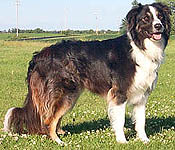 Four
more unusual colors are , sable, tan,
black-and-tan, and bindle. Four
more unusual colors are , sable, tan,
black-and-tan, and bindle.
Sable
means the hairs are tan at the base, with
a black tip. The amount of tan versus
black determines how dark (or light) a
sable dog will appear. Zip, right, is
a very dark sable.
|
|
|
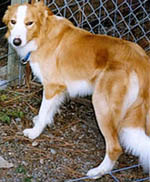 Tan
dogs, like Bud, right, are sometimes mistaken
for "collie crosses" because this color
is most often found in collies, and is
called "sable" in collies. Terminology
can be confusing because the same colors
may be called something entirely different
in different breeds, or the same name
might be given to one color in one breed
and another color in another breed, but
need not be worried about. Suffice it
to say that Border Collies do come in
this tan color. Again, the tan can be
any shade from a pale, "pinkish-beige"
to a deep, dark "mahogany". Tan is sometimes
mistaken for "red", as are the lighter
sables, so care at looking at a coat color
can often be the difference between identification
and misidentification. Tan
dogs, like Bud, right, are sometimes mistaken
for "collie crosses" because this color
is most often found in collies, and is
called "sable" in collies. Terminology
can be confusing because the same colors
may be called something entirely different
in different breeds, or the same name
might be given to one color in one breed
and another color in another breed, but
need not be worried about. Suffice it
to say that Border Collies do come in
this tan color. Again, the tan can be
any shade from a pale, "pinkish-beige"
to a deep, dark "mahogany". Tan is sometimes
mistaken for "red", as are the lighter
sables, so care at looking at a coat color
can often be the difference between identification
and misidentification.
|
|
|
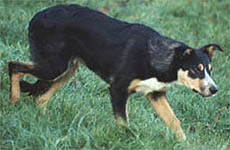 Border
Collies used to come in black-and-tan
(similar to the Rottweiler), but this
color has all but disappeared in the breed,
and dogs that are referred to as black-and-tan
often have a little white on them as well,
like Roy, right. Border
Collies used to come in black-and-tan
(similar to the Rottweiler), but this
color has all but disappeared in the breed,
and dogs that are referred to as black-and-tan
often have a little white on them as well,
like Roy, right.
|
|
|
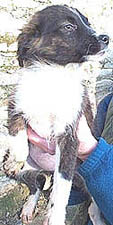 Brindles,
like Brenda, right, are very rare, and
occur when the hairs are banded, black
and tan, which gives a brownish cast to
the coat. Brindles,
like Brenda, right, are very rare, and
occur when the hairs are banded, black
and tan, which gives a brownish cast to
the coat.
|
|
|
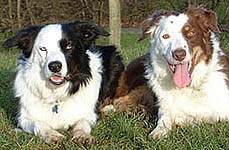
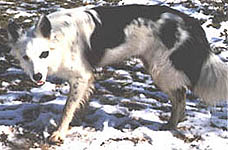
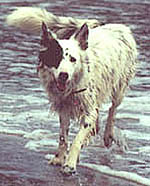 Besides
the usual white "collie" markings of collar,
blaze, feet and tip of tail, Border
Collies sometimes come with larger amounts
of white, such as half-white faces,
like Bizzi and Teddy, below left, which
is a very common pattern in the breed.
Speckling or ticking can occur on faces
and legs, but some dogs are ticked all
over, like Funny, right. These dogs are
usually born with their white areas completely
white and as they grow varying amounts
of spots begin to appear in the white
areas. Dogs that are born with lots of
white and some color in seemingly random
patterns, like Bandit, below left, are
often referred to as "patterned whites".
All these patterns can come in all colors,
not just black-and-white. Besides
the usual white "collie" markings of collar,
blaze, feet and tip of tail, Border
Collies sometimes come with larger amounts
of white, such as half-white faces,
like Bizzi and Teddy, below left, which
is a very common pattern in the breed.
Speckling or ticking can occur on faces
and legs, but some dogs are ticked all
over, like Funny, right. These dogs are
usually born with their white areas completely
white and as they grow varying amounts
of spots begin to appear in the white
areas. Dogs that are born with lots of
white and some color in seemingly random
patterns, like Bandit, below left, are
often referred to as "patterned whites".
All these patterns can come in all colors,
not just black-and-white.
|
|
|
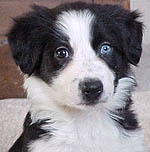 EYES:
One more word, on Border Collie eyes.
Most common in black-based dogs are dark
brown eyes. But Border Collies of any
color can have blue eyes, or one blue
eye, like Josie, right. This latter is
often referred to as "walleyed". Black-based
dogs can also have amber eyes, but eyes
of this color are most often found in
red dogs. Blue dogs often have green eyes
or grey eyes. In other words, eyes can
be just about any color, and are not important
for identifying the breed of a dog. Since
Border Collies come in such a wide variety
of colors and patterns, going on body
shape, head and muzzle shape, and ear
and tail carriage is much more important
for identification. And most important
of all is behavior. EYES:
One more word, on Border Collie eyes.
Most common in black-based dogs are dark
brown eyes. But Border Collies of any
color can have blue eyes, or one blue
eye, like Josie, right. This latter is
often referred to as "walleyed". Black-based
dogs can also have amber eyes, but eyes
of this color are most often found in
red dogs. Blue dogs often have green eyes
or grey eyes. In other words, eyes can
be just about any color, and are not important
for identifying the breed of a dog. Since
Border Collies come in such a wide variety
of colors and patterns, going on body
shape, head and muzzle shape, and ear
and tail carriage is much more important
for identification. And most important
of all is behavior.
If you are interested in seeing more
examples of Border Collies in the colors
and patterns discussed above, please visit
Carole Presberg's Border
Collie Museum.
back to the
top
|
|
|
|
| |
|
|
|
|